Kuya Ed (vignette)
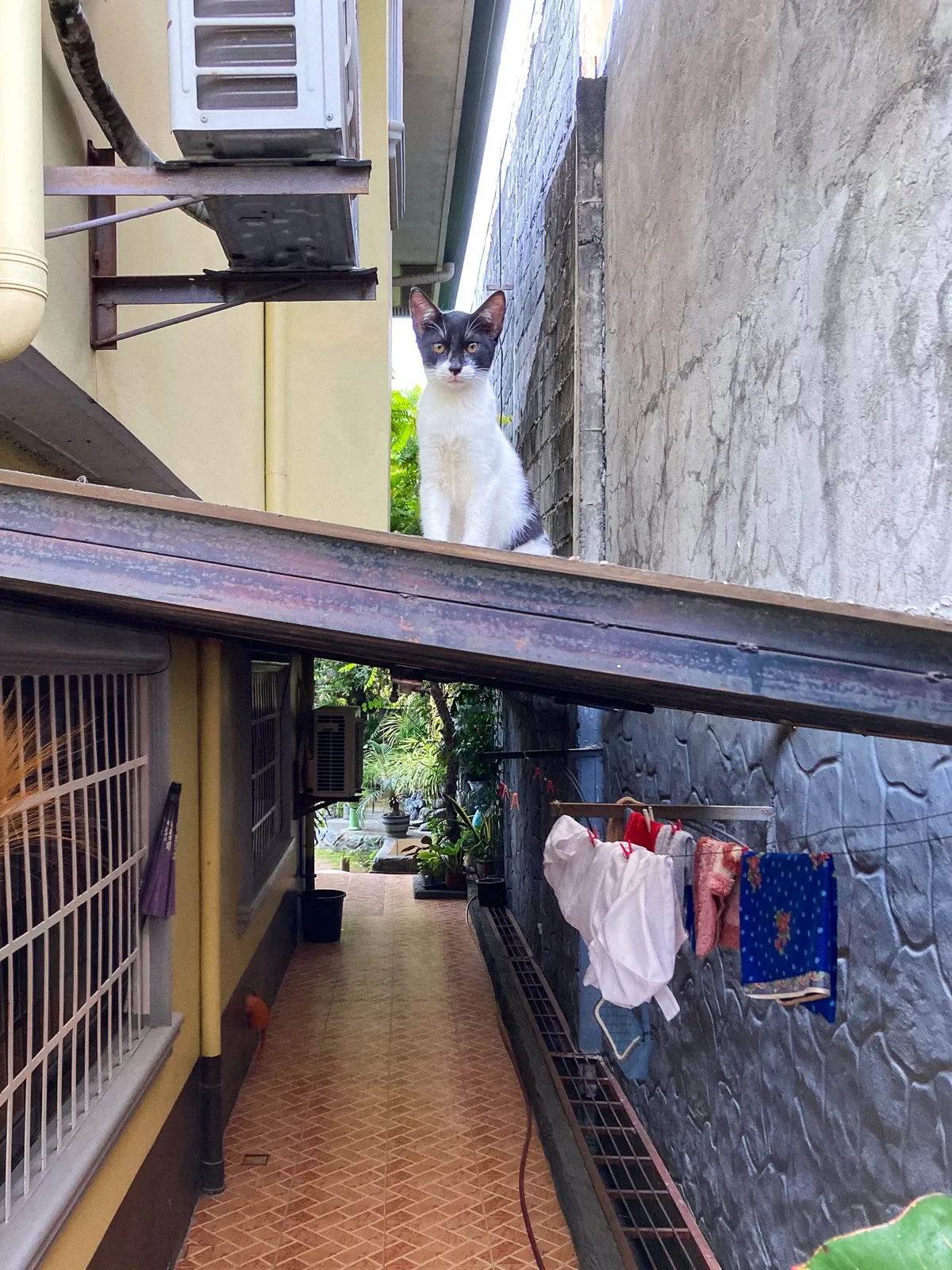 Puspin (Tagalog, street cat), Paniqui Philippines.
Kuya Ed lived between two high hollowblock walls. In the morning, he would pull apart the sliding glass doors and pull apart the mosquito screens and rattle the sliding bolt free and push the iron latticework gates open with a groan and let the smells of rain and hibiscus and mango wash over his face. Thus he would greet the day. Sunrise had already been greeted by the fighting cocks next door, though with the whoosh of the single room air conditioner and the eeeee of his tinnitus and his 19 years in the provinces, he hadn't heard most of the cockadoodle-dos, not consciously.
Ché had made eggs over easy and toast and cocina and had left the old green plate for him under a paper towel on the counter. The yolks were large and glistening and orange. He liked that. It reminded him that the eggs had been red and the chickens who'd laid them were colorful and thus his life was better here than back home, where everything was white. The cocina was nothing special. That deep red sausage was too sweet and too tough and too familiar. He would give half of it to Jubee, who now lay belly up with his legs shamelessly wide apart inside an iron cage, which looked like it was made for a lion in the early 1900s. It had been painted and filigreed like a Jeepney and the dog seemed at peace in his royal apartment, shaded from the tropical sun by the giant mango tree. He would sleep all day and occasionally rise to drink water. He would resume his patrol duty at night, just before Ed went to sleep.
Jubee was never petted. Kuya Ed did not want him to like people, not even himself. He was not alone in this approach; he had adopted it from the locals. There were dogs which were pets — tiny poofy things that couldn't whoop a tomcat — and there were dogs you protected your property with — a tan or black mutt the size of a small German Shepherd that had evolved in this land to this purpose. These two types of dogs were not the same thing. Their lives could be most easily distinguished by where they were never seen: The guardians never came into the house, and the pets never went outside.
The cats had their own thing going on. They had the cabana, which Kuya Ed's adult children hadn't slept in for years. The three amigos were an orange tabby and a white, black, and brown calico, and a grey Siamese who moaned from a cage because she was blind and would only hurt herself if she tried to keep up. Other cats came and went; they leapt from tin roof to tile and climbed down the thick ivy and lowered their heads coilspringed and black-eyed among the flowers when they saw the dart of a rat, the slide of snake, or the slow white mist of a ghost at sundown.
The three amigos were steadfast, and so they had been named: Mick the tabby and Panther the calico and Wushu the poor blind Siamese. The other cats, the ones who drew Jubee's ire at three in the morning when they appeared on the roof and searched for rats, were hunters allowed on the property for that purpose, and while Kuya Ed tolerated them, he never fed them.
Sometimes Wushu heard the hunt and cried out to join them, and her lonely wail would summon a White Lady, but Ed usually slept through that, too. If three roosters tethered by chains and stakes couldn't wake him, the silent wandering of a White Lady reliving her final moments for the cats to see had little chance of stirring Kuya Ed, who never let ghosts into the house, either.
That was a joke he told his wife. She was local, so she smiled in a way that said, "I don't want to contradict my husband" and also, "I wouldn't mock the White Lady."
She knew that most dogs and men can't see ghosts the way cats and women can, if they're not distracted. Which is why Ed sometimes saw that look on her face, as she looked right through him to what was coming.